
About us
Spiritual Objectives
To seek God with an undivided heart, in the Syrian, Indian and Cistercian traditions.
Monastic life is common to the great religious traditions of the world. In India it originated centuries before Christianity, prompting the noted theologian Raimundo Panikkar to call it the “primordial religious dimension”. And yet it is well and truly a mystery, a spiritual reality that eludes clear explanation. What follows is an overview of what monastic life is all about and, more specifically, how it finds expression at Kurisumala Ashram.
The monastic charism
What is the monastic charism? Simply put, it is to seek God with an undivided heart. This calls for a radical renunciation of everything that clamours for the heart’s attention and tends to divide it. A Christian monk renounces home, possessions, marriage, the “world” and ultimately himself, in order that he may possess Christ and in turn be possessed by Him, and eventually be transfigured into His likeness. Though separated from the world by his renunciation, he nevertheless remains united with all in Christ, as Evagrius, one of the Church Fathers, has so rightly said.
In order to be truly ourselves, we must find ourselves in Christ—which can only be done if we lose ourselves in Him. This is our great vocation. Thomas Merton, the famous Cistercian author, on the monk’s self-emptying, or kenosis, effected through renunciation
Three charisms
This ancient tradition manifests itself at Kurisumala in three distinct strands: the three charisms of Kurisumala, as Francis Acharya liked to call them.
- Syrian Liturgy. An oriental and essentially poetic liturgy deeply rooted in the thought and language of the Bible, with a vivid sense of the resurrection.
- Indian Monastic Lifestyle. Inculturated, simple, nature-oriented and austere.
- Benedictine-Cistercian Spirituality. Based on the Cistercian interpretation of the Rule of St. Benedict, with its emphasis on community prayer, manual labour and lectio divina (meditative, prayerful, spiritual reading).
Syrian and Indian, joined
Syrian liturgy is replete with poems by the likes of St. Ephrem, aptly named the “Harp of the Holy Spirit”, and Jacob of Serugh. These poems are notable for their symbolic excellence, their richness of imagery and their ability to lift the believer’s heart. These devotional poems, and the predilection of the Syrian tradition for austerity and closeness to nature, make it ideal for an Indian setting.
The “marriage” between the Syrian and Indian traditions at Kurisumala shows itself in concrete ways:
- the Syro-Malankara Qurbana celebrated on Sundays and feast days, and the Bharatiya Pooja on weekdays
- the hymns sung at the regular prayer services, and the bhajans and keertans sung at the Satsang
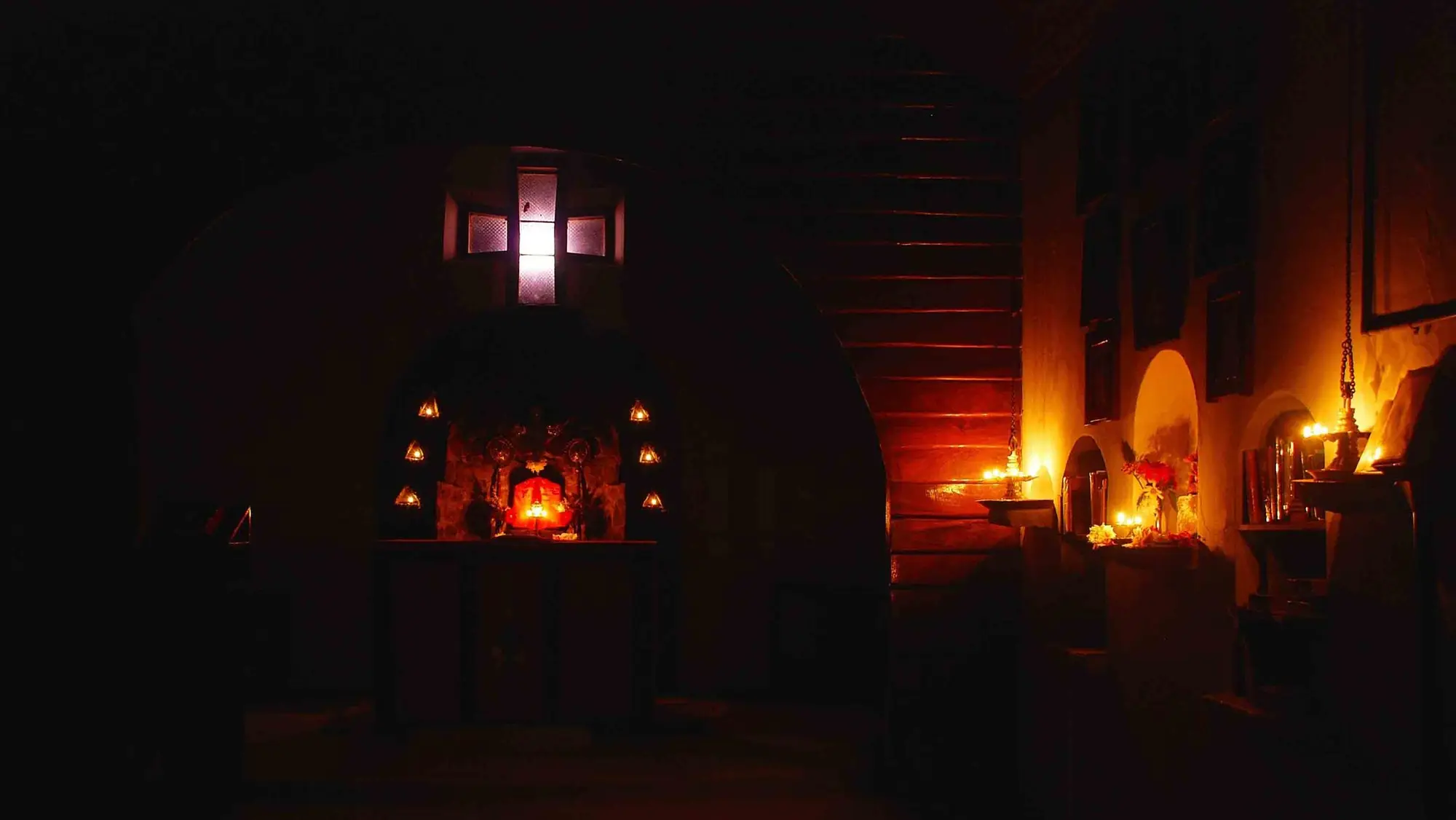
- the icons on the southern wall of the church, and the brass lamps before the tabernacle and elsewhere
- the saffron robes and bare feet of the sannyasis, and the colourful copes used during Qurbana
- the vegetarian diet and the sparse furnishings
Under a Rule and an Abbot
In the Benedictine-Cistercian tradition the monastic vocation is pursued in a monastery, under a Rule and an Abbot. Bound by vows of stability, fidelity to the monastic way of life (which includes poverty, chastity, simplicity and all other monastic practices) and obedience, the monks follow a life in community modelled on the early Church of Jerusalem. Drawing nourishment from the Holy Eucharist and from the spiritual riches of the prayers of the Church celebrated in the liturgy of the hours, they dedicate themselves to a life that is “ordinary, obscure and laborious”, a life of faith, hope and love.
Day in and day out they strive towards the ideal of unceasing prayer: prayer for the world, for the unity of the Churches and for peace.