Founder
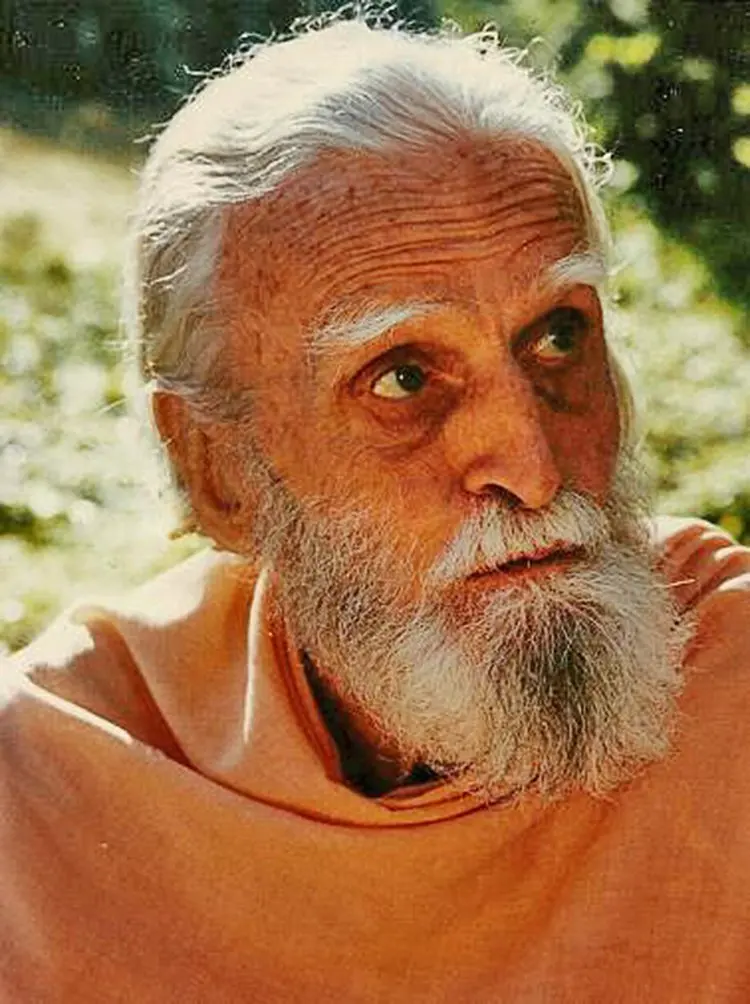
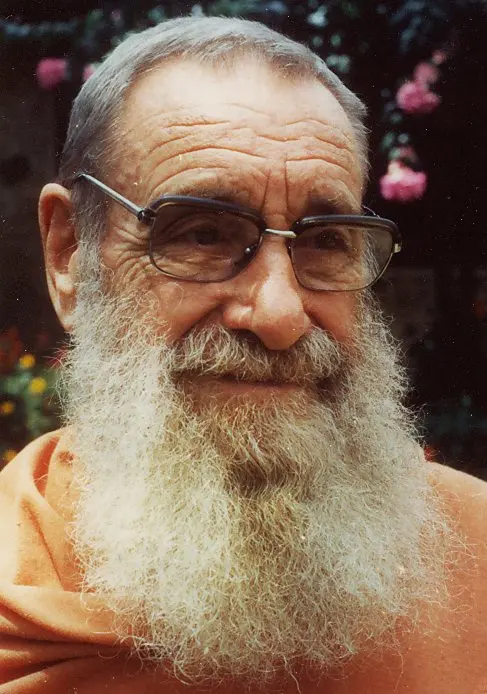
Fr. Francis Acharya OCSO
17.01.1912 – 31.01.2002
The Karmayogi of Kurisumala
Francis Acharya, well known in Indian monastic circles as one of the forerunners of the Christian Ashram Movement, crossed over to the Promised Land on January 31, 2002. His life began on the 17th of January, 1912, in Belgium, the land of missionaries, and came to an end in India, the abode of maharshis. He was ninety. “Our span is seventy years, or eighty for those who are strong,” says the psalmist (Ps. 90:10). “Ninety for those who are stronger,” one is tempted to add. A true Indian sannyasi with a many-sided personality, he was “still bearing fruit when old, still full of sap, still green” (Ps. 92:14).
Early days and vocation
John Mahieu, who in time became Francis Acharya, was the fifth son of a prosperous farmer. After schooling and business studies in Brussels, divine providence brought him to London. There his latent spiritual senses were awakened and captivated by Gandhiji, the so-called “half-naked fakir”, who had arrived for the Round Table Conference. The Mahatma’s apparent holiness and commitment to personal values struck a chord in John’s heart. It was a foreshadowing of the spiritual symphony that would soon follow.
John served in the Belgian army from 1932 to 1933, when the finger of the Lord beckoned him to His ranks to fight a new kind of warfare, an unseen and interior one. After a period of profound pondering he left the army and entered the Trappist (Cistercian) monastery of Our Lady of Scourmont at Chimay, Belgium, taking the name Francis. He had chosen that monastery because its Abbot, Dom Anselm le Bail, a reformer and visionary in his own right, was planning to establish a foundation in India, the land of Mahatma Gandhi. Francis served as novice-master there from 1946 to 1949 and later at Caldey Abbey in Great Britain.
Scourmont later dropped its plans for an Indian foundation. After twenty years as a Trappist monk and priest, with degrees from Rome, Louvain and Paris, Fr. Francis found himself alone as he set sail for India. He was going to join two like-minded Frenchmen: Henri le Saux (Swami Abhishiktananda), a Benedictine monk, and Fr. Jules Monchanin (Swami Paramarubi Ananda), a missionary priest. They had already founded Saccidananda Ashram (Shantivanam) near Tiruchirappalli, Tamil Nadu.
Kurisumala Ashram
The months immediately following Fr. Francis’s landing at Bombay in July 1955 were pilgrim days. He travelled the length and breadth of India, absorbing the culture and traditions of this “cradle of monasticism”. His stay at Shantivanam with its founders lasted a year. Then came an invitation from Zacharias Mar Athanasius, Bishop of Tiruvalla in Kerala, and he decided to sink roots there. On March 21, 1958 he established Kurisumala Ashram (the “Syrian Shantivanam”, as Fr. Monchanin put it) near Vagamon, Kerala, in the company of Fr. Bede Griffiths, the well-known Benedictine monk, and a couple of aspirants.
Their lifestyle in the first days was rigorous and simple in the extreme. Whatever essential commodities they lacked, water was certainly not one of them. Monsoon rains lashed the mountainside with such fury that they soon realised the inadequacy of their thatched hut against the onslaught of humidity and the need for a stone building. Fr. Francis loved to recall how their primitive living conditions had brought tears to the eyes of their visiting Bishop, who once told them: “If I were free, I’d immediately join you!”
Enveloped by the elements in the shadow of the cross, this small nucleus grew into a koinonia of fifteen in three years, under the watchful eyes of Fr. Francis, who was their father, mother, confidant and guru. Of the scenic beauty of Kurisumala’s surroundings he wrote:
The sparkling jewels of the highlands of Kerala,
A land of grassy slopes with flowers of many hues,
With glades where fair trees dance in the wind…
By back-breaking labour, which is the lot of pioneers, they transformed this beautiful but infertile tract of land into a veritable paradise of green pastures, flower gardens and vegetable beds. Acharya’s search for a livelihood and his concern for the welfare of the needy people nearby led to the establishment of the Kurisumala dairy farm. This agricultural development and the cattle-breeding facilities soon gave Kurisumala the image of the promised land to many.
Three strands of daily life
Their daily life was woven out of three distinctive strands.
- Syrian Liturgy. An oriental and essentially poetic liturgy deeply rooted in the thought and language of the Bible, with a vivid sense of the resurrection.
- Indian Monastic Lifestyle. Inculturated, simple, nature-oriented and austere.
- Benedictine-Cistercian Spirituality. Based on the Rule of Saint Benedict, with its emphasis on community prayer, manual labour and lectio divina (meditative, prayerful spiritual reading).
Prayer with the Harp of the Spirit
Modelling their life on the early Church of Jerusalem, they lived the common life to the hilt, sharing living quarters, basic amenities and goods. Prayer services were at first in Syriac. Fr. Francis, driven by the typical Cistercian search for authenticity, travelled all the way to Iraq and managed to procure original Syriac prayers of the Antiochene rite (the Penqitho). Through a Herculean effort spanning nearly two decades, he translated selected portions into four volumes totalling 2,300 pages, named Prayer with the Harp of the Spirit.
“…He has freely used his sources with striking effect, reflecting the Christian freedom and creative genius of the great masters of liturgical prayer in the past,” wrote Orientalia Christiana Periodica of the Pontifical Oriental Institute, Rome, praising the first of the four volumes, adorned as it is with “seeds of the word” gleaned from the spiritual heritage of India.
His fecund pen also produced a book of daily readings on the lives and sayings of saints from different religious traditions, a lectionary with commentary for the liturgical feasts of the year, a translation of the Ritual of the Clothing of Monks in the Syrian tradition, and some other unpublished works. He also took an active interest in publishing Malayalam translations of two gems of Eastern Christian monastic spirituality, The Philokalia and The Ladder of Divine Ascent.
Home to the Cistercian shore
Immersed in the regular monastic milieu of prayer, work and spiritual reading, this small band of sadhakas, brahmacharis and sannyasis continued to cross milestones: Fr. Francis’s Indian citizenship, Fr. Bede’s departure to Shantivanam as its superior, Fr. Francis’s shashtiabdapurti and his taking up the title of “Acharya”, and the introduction of the Bharatiya Pooja.
Ever the able and concerned captain, he piloted Kurisumala Ashram back to the Cistercian shore towards the end of his earthly voyage. In July 1998 Kurisumala was incorporated “as it is” into the Cistercian Order of Strict Observance, with the status of Abbey. The title of Abbot was conferred on him a year later, just before the Cistercian General Chapter at Lourdes, where he was the doyen and, in another sense, the babe.
Little wonder that his twilight days were brightened by an ever-radiant face that spoke volumes of his inner joy and contentment at having run a good race. When heart failure transported him from time to eternity, the first words he heard must surely have been, “Well done, good and faithful servant…”
His body was taken to Pushpagiri Hospital, Tiruvalla, where it lay on display for four days in a glass-sided mortuary, only a stone’s throw from the Bishop’s home where he and Fr. Bede had begun their lives as sannyasis before setting out for Kurisumala. Another remarkable coincidence was the place where his mortal remains were finally laid to rest: the former pilgrimage shrine at the Ashram, right next to the site where they had set up their first hut and begun life at Kurisumala. These curious coincidences of beginning and ending at the same place could perhaps be signs that he returned straight to the embrace of the Heavenly Father from whom he began his earthly pilgrimage.
Francis Acharya the man
Fr. Francis Acharya was a man of many sides. Short of stature but a giant in faith and resolve, he rubbed shoulders with patriarchs and peasants and became “all things to all people” in a real sense. He was a loving son to his parents, a genuine monk to his fellow cenobites, a man of verve and vision to his contemporaries, a spiritual father par excellence to his sons at Kurisumala and to many others, a gracious host to all who visited his Ashram, an unsung up-lifter of the poor in Vagamon, a true Gandhian to all Indians and an inspiration to many. It must be admitted that he was also a thorn in the flesh to some.
His strict and unyielding ways occasionally rubbed people the wrong way, especially in the early days at Kurisumala. Sometimes it was misunderstanding that caused problems. “It is puzzling to see how the best intentions, how works of dedication almost invariably arouse suspicions and opposition in one’s own circles and in other circles,” Fr. Francis said once in an interview.
In course of time the Lord smoothed the rough edges of His chosen instrument on the grindstone of adversity and physical suffering, so that sweetness and charm emanated from him towards the end, with only an occasional overcast to remind others of his garam masala days. “Father Francis yesterday and Father Francis today are as far apart as night and day,” was how a senior sannyasi put it. And so it was with heavy hearts and brimming eyes that the brothers of Kurisumala gathered around the death-bed of their beloved Father, realising that he had come full circle: from quick-tempered to serene, from demanding to understanding, from stubborn to docile.
He is no longer with us in flesh and blood, but his spirit lives on in the living tradition of Kurisumala Ashram, in the daily celebrations from Prayer with the Harp of the Spirit, and in a special way in the hearts of the poor folk of Vagamon.